Brand archetypes – bonding with your consumer
26 March 2021
This Article
In this 7-minute article we explore the concept of archetypes in general and brand archetypes in particular.
Subjects covered include;
- The history of archetypes
- The 12 brand archetypes – theory and practice
- How to use brand archetypes
- How to identify the most suitable archetype for your own brand
- How to ensure that your preferred archetype is the right one for your target audience
A quick history of archetypes
Brand archetypes have their roots in psychology.
Sigmund Freud kicked things off, with his psychcoanalytic theory of personality, in which he identified the unconscious mind as the repository for feelings, thoughts, perceptions and memories that lie outside the conscious mind. Freud believed that even though we are not aware of them, the contents of this repository exert considerable influence over the attitudes, decisions and behaviours of us all.

It was the Swiss psychiatrist and psychoanalyst Carl Jung who then advanced Freud’s thinking, with his theory of the existence of the collective unconscious.

Jung believed the collective unconscious contains a number of mythical archetypes (archetype meaning original pattern in ancient Greek), each reflecting a bundle of basic emotions, values, behaviours and ideas that were first experienced by our earliest ancestors and then passed down to us, as a sort of genetic inheritance.
Jung believed that, as a result of this inheritance, we are all hardwired to recognise these archetypes subconsciously, and are instinctively drawn to the one(s) that best suit our own emotional disposition and needs.
From archetypes to brand archetypes
In 2001, authors Margaret Mark and Carol S. Pearson expanded on Jung’s work in their book “The Hero and the Outlaw”, which was aimed at the marketing community. In it they explored how archetypes can be used to position brands in ways that fundamentally alter and enhance the consumers’ relationship with them.
The book identified 12 archetypes which between them reflect a spectrum of basic consumer needs and motivations. They are; The Innocent, Everyman, Hero, Outlaw, Explorer, Creator, Ruler, Magician, Lover, Caregiver, Jester, and Sage.
The Brand Archetype Wheel
The 12 archetypes reflect 4 underlying ‘orientations’ or need states that humans are seeking to attain, as follows;
- Structure Those motivated to create structure in the world
- Freedom; Those wishing to provide emotional or intellectual liberty
- Ego; Those wishing to challenge the status quo and leave their mark
- Social; Those motivated to connect with others
The relationship between the 4 orientations and the 12 brand archetypes can be clearly seen in the Brand Archetype Wheel;

The Brand Archetype Wheel - reproduced by courtesy of Iconic Fox - (https://www.iconicfox.com.au)
The overarching case for brand archetypes
The theory is actually a simple one; if a brand is able to identify the archetype that a) best reflects its personality and b) aligns most closely with the emotional needs of its target audience, then it has the opportunity to create a brand positioning capable of making a fundamental connection with that consumer group.
But brand archetypes are far more than just brand positioning templates. Their detail can be used to help craft the brand’s value proposition, values, essence, purpose and tone of voice.
The 12 brand archetypes in detail
1. The Everyman Archetype

Additional Everyman brands include Tesco and Volkswagen. Consider this Volkswagen brand and the extent to which it aligns with The Everyman archetype;

The ad reflects common Everyman attributes (e.g. belonging, solid virtues, being down to earth, lack of pretence) in a way that is both highly insightful and creative. These characteristics have been common across VW’s advertising over many years.
2. The Creator Archetype

Infographic courtesy of Iconic Fox
The Apple brand and it’s Think Differently strategy fits perfectly with the Creator archetype.
Apple has been hugely successful in positioning itself and its products as individual, authentic, and creative – a credible alternative to the mainstream.
This positioning has enabled it to made a deep, emotional connection with members its fanatically loyal customer base, for whom the brand acts as a means of self-expression and an extension of their own personalities.
Apple perpetuates this positioning in its ongoing product development and marketing, being careful to ensure that every new product launch experience has a ground-breaking feel it; the thinnest, the most powerful, the most aesthetically appealing…….
The remaining brand archetypes are as follows;
3. The Innocent Archetype
Innocent brands are honest, pure, trustworthy and wholesome. They convey optimism and steadfastness. Innocent brands include Dove, Disney and Innocent smoothies.
The Innocent brand doesn’t make the list because of its name, but because, since its inception, it has combined the purity of its products with the playfulness in its communications.

4. The Hero Archetype
Hero brands are bold, inspiring, reliable and aspirational. They challenge rather than nurture and act as the benchmark for their competitors to follow. Example brands include: BMW, Duracell and Nike, with its “Just Do It” Logo, encouraging its audience to be the best they can be.

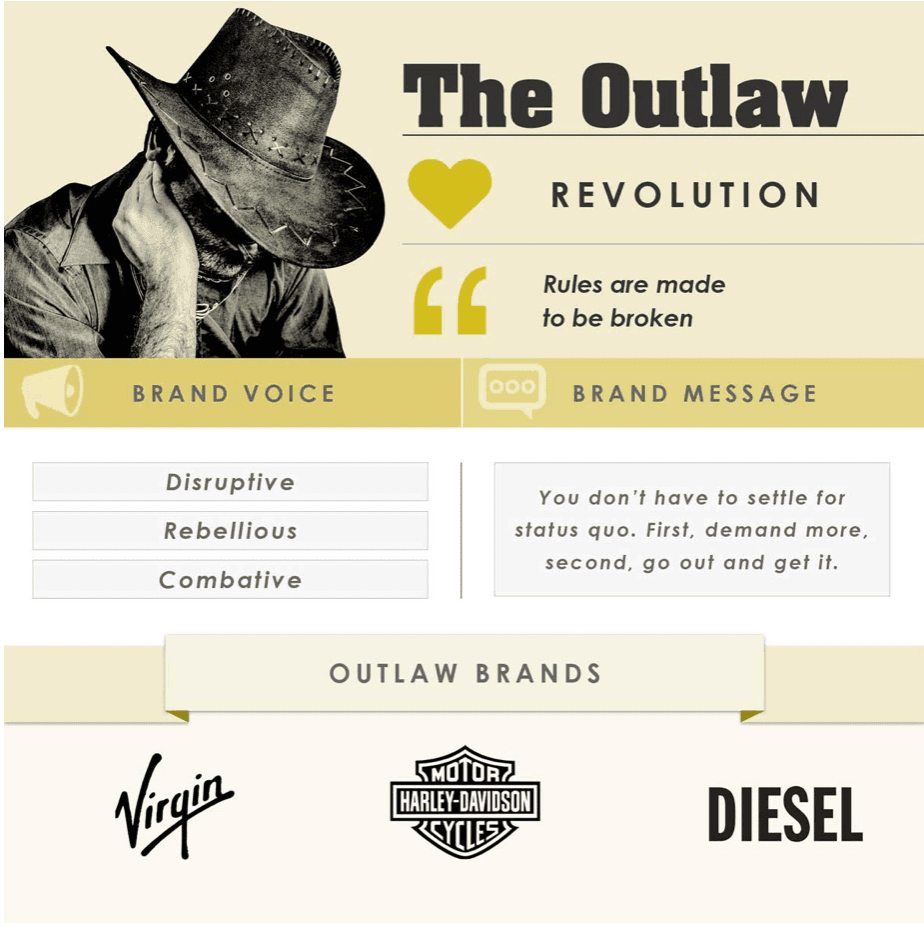
5. The Rebel Archetype
Rebel brands adopt an anti-establishment stance and stand for freedom from convention and mediocrity. For those who want to make a statement and be seen to stand slightly apart. Brands include Virgin, Harley-Davidson and Brew Dog, the craft beer brand taking on the mainstream beers with its feisty, punk attitude.

6. The Explorer Archetype
Explorer brands stand for discovery, thrill seeking and preservation, leading to self-enlightenment. Example of brands that reflect this brand archetype include Land Rover and Patagonia.

7. The Ruler Archetype
Ruler brands stand for order amongst chaos. They regard themselves as a cut above. . Ruler brands are calm, understated, powerful, organised and consistent. They enjoy leadership and even control. Brands that reflect the Ruler archetype include Mercedes-Benz and Rolex.

8. The Magician Archetype
Magician brands are spiritual, focussed on turning ordinary in to special and dreams in to reality. Brands reflecting the Magician archetype include Disney and Coca Cola. Coke has long-produced magical ads such ‘Holidays are Coming’ and the hilltop “I’d like to buy the world a coke’ execution, which showcase the brand’s ability to spread happiness and joy everywhere.

9. The Lover Archetype
Lover brands are sensual and passionate, determined to create and celebrate truly special moments. Example brands include: Victoria’s Secret, Chanel, Haagen Dazs and Dior.

10. The Caregiver Archetype
Caregiver brands are focussed on protecting and caring for others. They are established, generous, nurturing, strong and unquestioning. Examples of this archetype include Dettol, Johnson & Johnson, the Red Cross and British Airways.

11. The Jester Archetype
Jester brands are joyful, mischievous and irreverent, determined to make the day brighter. Their raison d'être is to spread happiness and good humour. Example brands include: Ben & Jerry’s and Snickers.

12. The Sage Archetype
Sage brands perform the role of advisors and mentors, there to impart their wisdom and create understanding. Sage brands are constantly looking for truth. Example brands include: BBC and Google.

How do you identify the best archetype for your own brand?
Whether your brand is going to adopt one of the 12 brand archetypes or another sort of brand persona that mixes and matches different personality traits, the place to start is not with your own brand, but those of the competition.
If you map your competitor brands according to the personality of each, you will find areas of your map where there is considerable brand overlap. These are ‘obvious’ positioning territories, but ones that are already fiercely contested, meaning that the brands occupying them are effectively cancelling each other out.
The positioning territory you seek should be one that;
- Your brand can own. That means that it is likely to be territory that is largely unpopulated by other brands, or is populated unconvincingly at present
- Is a natural fit for the way you see your brand – or would like it to be seen
- Can support the price and the usage occasions / frequency you project for your brand
There are several workshop techniques you can use to identify the most fertile positioning territory for your brand. Once identified, it will enable you to rule in / out the brand archetypes that could be applied.
Having used the territory mapping exercise to identify potential archetypes for your brand, your archetype candidate(s) in the context of your target audience, in order to determine whether the archetype(s) you are considering will be capable of establishing the sort of emotional connection that is required.
Qualitative market research is required here to first identify the defining personality traits, emotional needs and aspirations of your target audience and then assess archetype suitability and appeal within the context of these.
Having assessed your archetype options in relation to your brand, your competitors and your customers, you are now in a position to select the one that will be most capable of differentiating your brand whilst resonating strongly with your customers.
Brandspeak
Brandspeak specialises in brand market research and consulting for B2B and B2C brands. To understand more about the options for your brand please contact us at enquiries@brandspeak.co.uk























Client Feedback
We worked with Brandspeak on a brand awareness project and we were extremely pleased with the quality of service and the process. They understood the complexity of the briefs and asked plenty of questions to make sure they fully understand the objectives. They interacted with all levels of people in our business and understood the differences within the market and suggested ways to tie the research together so it was still comparable. The results were delivered with easy to digest summaries that could be used across the business. We would highly recommend using them.
Lauren Williams
Very informative, easy to work with and a really friendly team. I would recommend Brandspeak to help any business grow. They are great quality for money, help niche sectors and present their findings in an understanding manner. They have provided a brand review, market review post-covid to ensure we are still up to date, along with two very valuable website reviews. Working with them for qualitative and quantities research has a been fantastic for us. Thank you for all your help!
Sarah Twist – Marketing Manager

It's been an absolute pleasure to work with Brandspeak on our qualitative assessment of different ads across 5 EU markets. Throughout this project, Brandspeak have been expert, professional and so flexible with our requirements and timings. The research analysis that they provided us with was extremely valuable and insightful. I look forward to working with them again – highly recommend!
Zanya Fahy

Great service from Brandspeak – highly recommend for thoughtful and detailed brand measurement and tracking.
Georgie Burks, Brand Marketing Lead
Brandspeak have been fantastic to work with. They are a very professional agency who really understand the importance of quality research. Their team were very responsive, knowledgeable and easy to work with and provided us with excellent insights.
Mark Wilson

We wanted to understand how elements of our brand were perceived by consumers and identify opportunities where we could make improvements. Brandspeak clearly understood the brief and worked closely with us to develop a research approach that would answer our questions. The insight has been used to inform the development of our creative and also applied to other areas of our marketing communications. It was a pleasure to work with Brandspeak.
Strategy & Insight Manager | Animal Friends Insurance

Brandspeak helped us with getting invaluable market insights! They showed great flexibility and professionalism throughout the entire process and provided us exactly with the results we needed. I would recommend working with Brandspeak to anyone and anytime.
Tom Suberg
From the moment I contacted Brandspeak I can't thank Jeremy and his team enough. Offering a professional approach they took the time and effort to make the whole process easy and effortless. I highly recommend Brandspeak and look forward to working with them again in the future.
Verity Kimber
From their initial proposal they displayed an understanding of financial services and a clarity of thinking that made them stand out. Since then they have consistently delivered to demanding timescales. But what really sets them apart are their actionable and business focused recommendations which give them the credibility to influence senior internal stakeholders. I have really enjoyed working with them and look forward to doing so again.
Leading life and pensions provider
It is always a pleasure – and a relief! – to work with researchers who get the whole thing – effortlessly... a heartfelt thanks.
DLKW